 Find my nearest Depot
 Contact


Some projects stay with you long after the work is finished.
In August 2026, we had the privilege of supporting archaeologist Colin Welch and Research Resource Archaeology during the licensed excavation of an early Battle of Britain Spitfire crash site near Selsted in Kent.
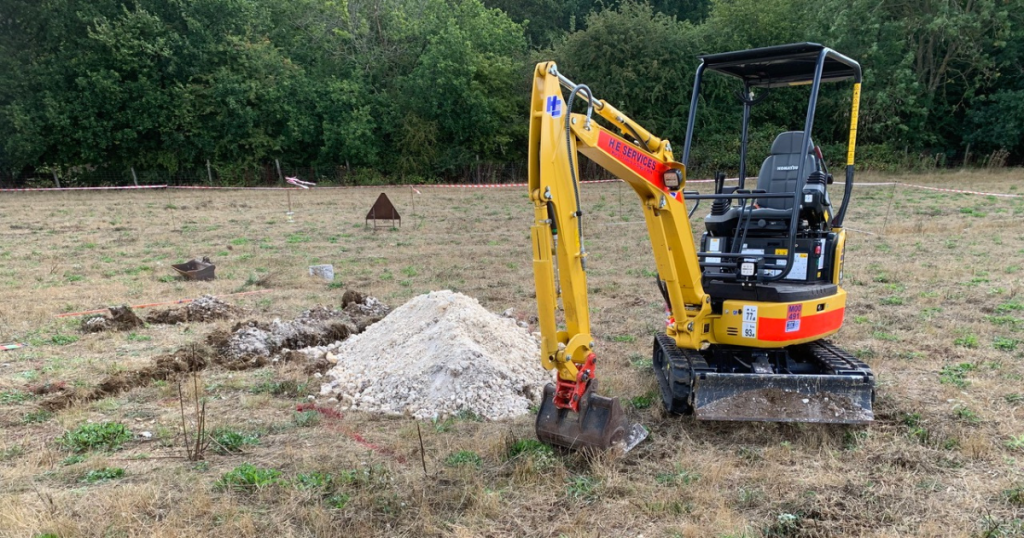
The three day excavation took place between 21 and 23 August. We supplied one of our Komatsu PC16 mini excavators to assist with the investigation. For us, this was much more than another machine on hire. It was an opportunity to play a small role in preserving an important piece of Britain’s wartime history.
Investigating an Early Battle of Britain Crash Site
The excavation focused on the site of an early Battle of Britain Spitfire crash near Folkestone and Canterbury. While the exact location remained confidential during the investigation, the project can now be discussed publicly following the completion of the excavation.
The aim was not simply to recover aircraft fragments. The team wanted to understand the site properly and create a detailed archaeological record. Every piece of evidence had the potential to contribute to a wider understanding of the aircraft and the events surrounding its loss.
This careful approach is what makes archaeological investigations so valuable. They help preserve information that could otherwise be lost forever.
Recovering Important Evidence
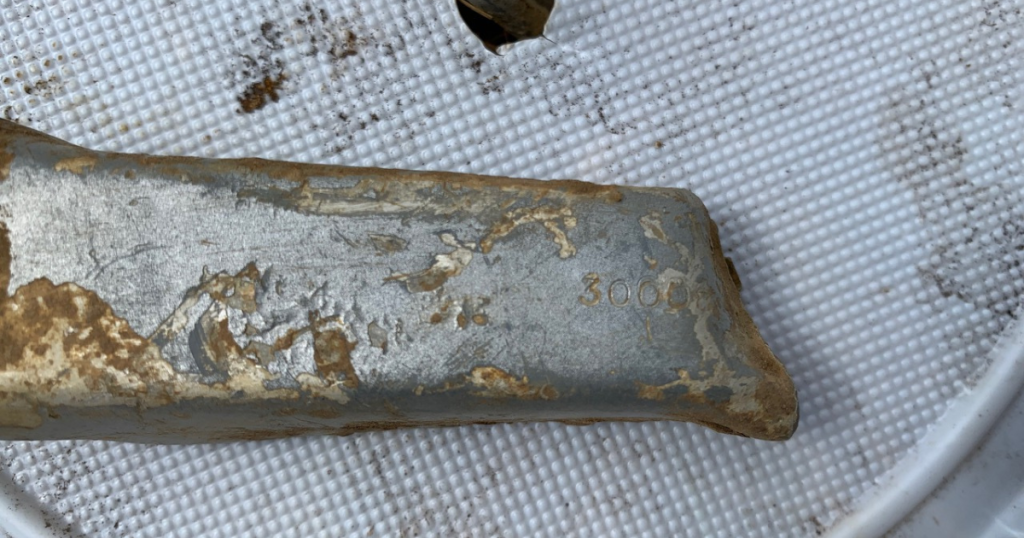
During the excavation, a significant quantity of Spitfire debris was recovered from the upper soil layers. Among the finds were numerous aluminium alloy fragments and aircraft components carrying identifiable reference numbers.
Several parts featured the “300” prefix associated with Spitfire components. Some appeared to have originated from the aircraft’s wings. As well as this, the team also recovered .303 ammunition from the site. One particularly unusual discovery was a round dated 1926.
Each recovered item will now undergo conservation and further examination. This process may reveal additional information about the aircraft and the original position of individual components within the crash site.
Archaeological work rarely ends when the digging stops. In many cases, the analysis that follows is just as important as the excavation itself.
A Mysterious Magnetometer Reading
One of the most interesting moments of the project came on the final day.
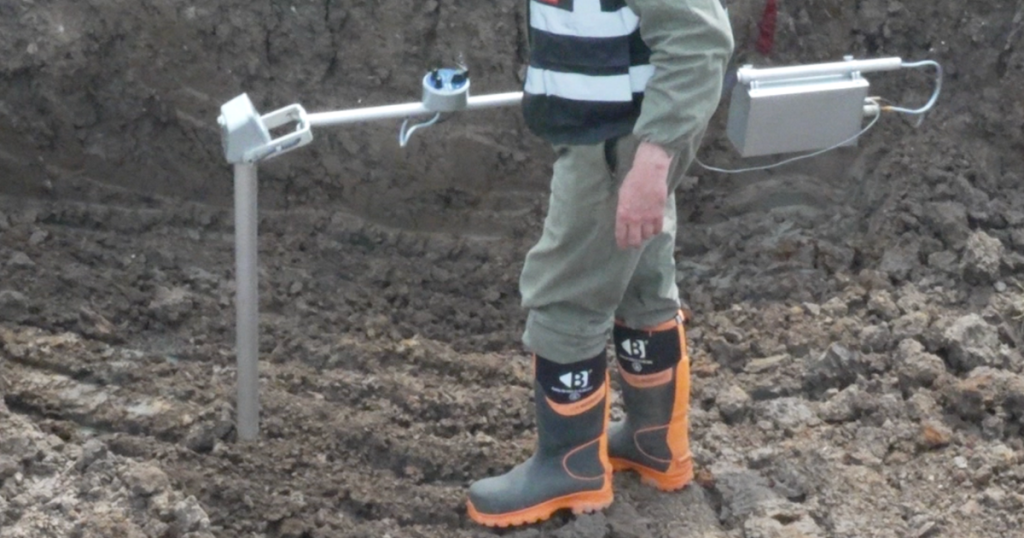
The archaeological team wanted to investigate a significant magnetometer anomaly detected at the site. To do this, an evaluation trench measuring approximately 300mm wide and 1.8 metres deep was excavated across the location using our Komatsu PC16.
Initially, the team expected the magnetic signal to become stronger as they excavated deeper. Instead, the opposite happened and the readings became weaker as the trench progressed.
This unexpected result led to further investigation using two separate magnetometers and the team soon established that the strongest readings were coming from the topsoil rather than a buried aircraft component.
The explanation proved to be highly unusual.
An Unexpected Discovery
The source of the magnetic signal turned out to be pieces of magnetic material scattered throughout the soil. The material appeared similar to the magnetic strip commonly found in fridge door seals.
Although it generated a strong response on the magnetometers, it could not be detected using conventional metal detectors which raised fresh questions about the site’s history.
One local account had suggested that an amateur excavation may have taken place in the area during the 1980s.
Following the recent excavation, a local resident reportedly confirmed that a dig had occurred at the same location around 40 years ago.
One theory is that the magnetic material may have been deliberately placed as markers during that earlier investigation. At present, this remains speculation and cannot be confirmed. Even so, it highlights how archaeological sites can develop their own history over time. Sometimes the evidence uncovered relates not only to the original event but also to later activity at the location.
Creating a Lasting Archaeological Record
While the recovered finds are important, one of the most significant outcomes of the project is the creation of a formal archaeological record as no such record existed for the site before this excavation.
That means valuable information has now been documented, preserved and made available for future research.
For Colin Welch and the team at Research Resource Archaeology, this represents a major achievement.
Archaeology is not simply about uncovering objects. It is about recording evidence and ensuring that knowledge is not lost. The Selsted excavation has now created a permanent record that future researchers can build upon.
Combining Traditional Archaeology with Modern Technology
The excavation also demonstrated how modern technology is transforming archaeological investigations.
The team used specialist GPS equipment capable of recording finds to within approximately one centimetre accuracy. This level of precision allows discoveries to be mapped and analysed in remarkable detail, and every significant find can be plotted accurately and incorporated into digital plans for the final archaeological report.
The technology was especially useful because the excavation area was located on a steep slope.
Using GPS data, the team established an accurate reference area and related excavation findings to drone imagery captured above the site.
The result is a much more detailed understanding of the excavation than would have been possible in previous decades.
Why the Komatsu PC16 Was the Right Choice
Although archaeological excavations demand great care, plant machinery still plays an important role.
The challenge is selecting equipment that provides the required performance while allowing investigators to work with precision but our Komatsu PC16 proved ideally suited to the task.
Its compact size allowed the archaeological team to excavate the evaluation trench efficiently while maintaining a controlled approach. This helped the team investigate the magnetometer anomaly safely and accurately.
Projects like this demonstrate that compact excavators can be valuable tools outside traditional construction environments. From utilities and landscaping to specialist archaeological work, the right machine can make a significant difference.
Supporting Projects That Preserve Britain’s History
At H. E. Services, we support projects across a wide range of sectors throughout the UK.
This excavation stands out because of its connection to one of the most important periods in British history. The Battle of Britain remains a defining chapter of the Second World War. For more information about the Battle of Britain, you can visit the Royal Air Force’s Battle of Britain history page.
To have one of our machines involved in investigating an early Battle of Britain Spitfire was a genuine privilege.
Most importantly, the project has created a formal archaeological record where none previously existed.
That contribution will remain long after the excavation itself has been completed.
The fieldwork may now be finished, but the research continues and the recovered Spitfire fragments will undergo further conservation and examination in the months ahead.
Those investigations may reveal even more about the aircraft, the crash site and the events connected to it.
We are proud to have supported Colin Welch and Research Resource Archaeology throughout this fascinating project and look forward to seeing what future research uncovers.
Give us a call on: 0208 804 2000 or email us for a quote.
For more special offers and construction news, don’t forget to follow us on social media:
Facebook – https://www.facebook.com/planthireHE/?locale=en_GB
LinkedIn – https://www.linkedin.com/company/h-e–services-plant-hire-ltd/
Instagram – https://www.instagram.com/planthirehe/
TikTok – https://www.tiktok.com/@heservicesplanthireltd
All information correct as of: 14/09/2026
