 Find my nearest Depot
 Contact

When people think of excavators, they usually picture construction sites, roadworks and major infrastructure projects. They probably do not think about uncovering the remains of a Second World War flying bomb.
That is exactly what happened when we supported an archaeological excavation at Chetney Marsh in Sittingbourne, Kent. Working alongside the team at Research Resource Archaeology, our Komatsu PC14 R-3 mini excavator helped uncover a remarkable piece of history that had remained hidden for more than 80 years.
It is not every day that a plant hire company gets the chance to be involved in a project like this, and we were delighted to play a part.
A Rare Opportunity to Investigate the Past
The excavation was led by brothers Colin and Sean Welch, founders of Research Resource Archaeology, alongside a team of archaeologists and volunteers. Their mission was to investigate the remains of a German V1 flying bomb that crashed at Chetney Marsh in 1944.
Often referred to as a “doodlebug” or “buzz bomb”, the V1 was one of thousands launched towards Britain during the Second World War. Many of these sites have since been lost to development or altered over time, making surviving locations increasingly valuable to researchers and historians. As highlighted by Historic England’s work to protect important heritage sites across the country, preserving physical links to the past helps us better understand significant moments in history. Fortunately, this location remained largely untouched, giving researchers a rare opportunity to study the impact site in its original setting.
There was another reason the team were excited about the project. The V1 had become buried in soft blue clay, a soil type that limits oxygen exposure and helps preserve artefacts. In simple terms, there was a good chance that important parts of the flying bomb had survived underground.
As it turned out, they were right.
Bringing the Site to Life
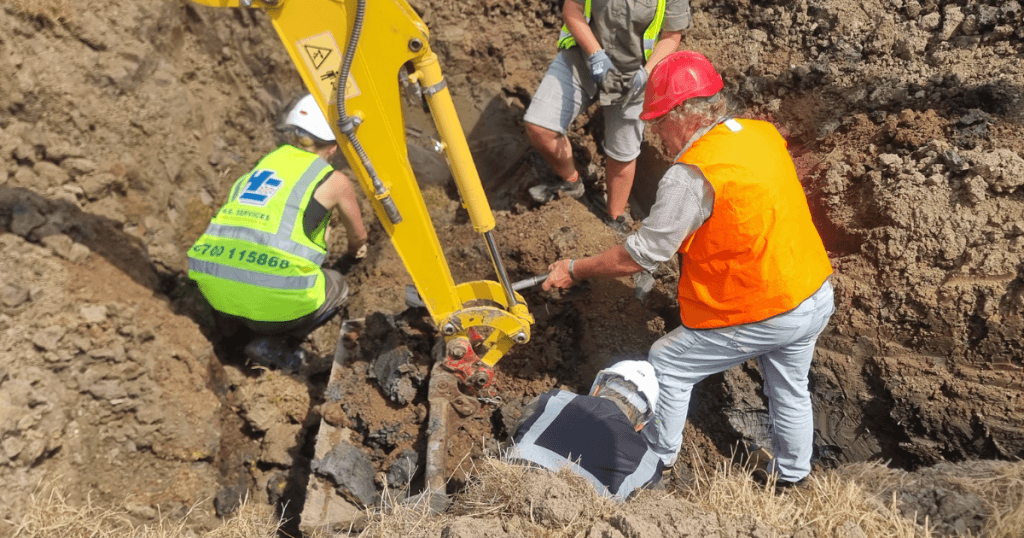
Before archaeologists could begin carefully examining the site, overlying material needed to be removed. That is where our Komatsu PC14 R-3 mini excavator came in.
We supplied the machine to support the excavation, helping the team expose the impact area safely and efficiently. Once the site had been opened up, archaeologists could continue the investigation by hand and begin recording key evidence.
Projects like this require a very different approach to most excavation work. Every bucketful of soil has the potential to contain valuable information, so precision is everything. The compact size and precise controls of the Komatsu PC14 R-3 made it perfectly suited to the task.
While our machines are more commonly seen supporting construction, infrastructure and utilities projects, it was fantastic to see one helping uncover a chapter of British history.
What Did the Team Discover?
As the excavation progressed, the team began uncovering surviving parts of the V1. Some of the discoveries were particularly significant.
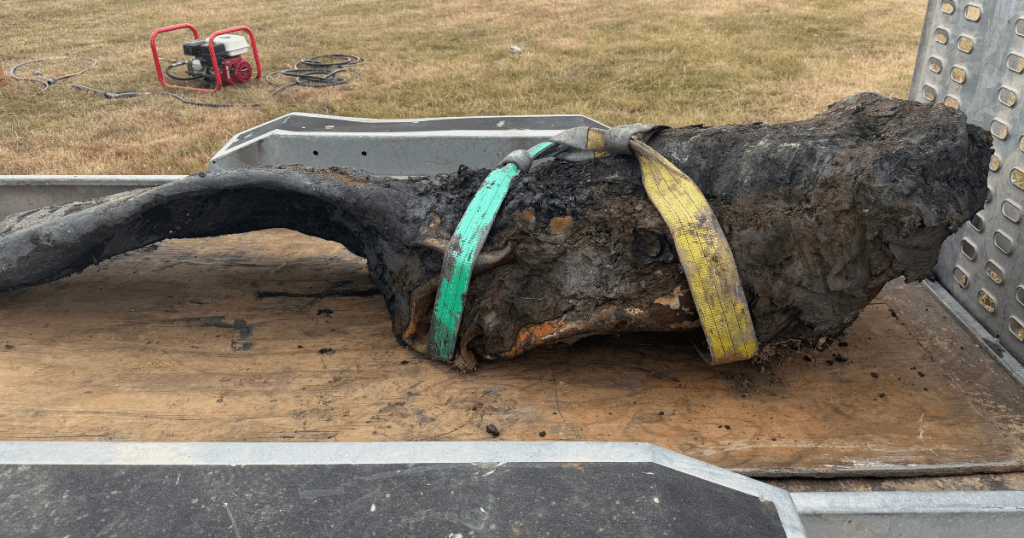
Among the recovered items were the launch lug and sections of the Argus pulsejet engine. One of the most exciting finds was the condition of the engine itself, which was found to be almost complete despite spending decades underground.
Each discovery was carefully recorded and documented before being removed from the site. This helps researchers build a clearer picture of what happened while ensuring important evidence is preserved for future study.
For the archaeological team, the finds offered a fascinating insight into the technology behind the V1 programme. For those of us following the project, it was incredible to see history literally being uncovered piece by piece.
A Story That May Not Be Quite What It Seems
One of the most interesting aspects of the excavation is that it could challenge what we thought we already knew.
Historical records suggest this particular V1 was brought down using the famous “wing tipping” technique. This involved a pilot carefully placing their aircraft wing beneath the wing of the flying bomb and forcing it off course.
However, evidence recovered during the excavation suggests there may be more to the story.
According to Colin Welch, the findings indicate the V1 may also have been struck by anti-aircraft fire and aircraft ammunition before it crashed. If further research supports this theory, it could add an important new layer to the historical record.
That is what makes projects like this so fascinating. Even more than 80 years later, there are still new discoveries waiting to be made.
More Than Just Another Excavation
For us, this project was a reminder that plant machinery can be used in ways many people would never expect. The same equipment that supports modern construction can also help uncover evidence from the past.
It was a privilege to support the team at Chetney Marsh and see the excavation develop from the first stages of site preparation through to the recovery of key artefacts. Watching the story unfold was every bit as fascinating as the discoveries themselves.
The project also highlighted the importance of collaboration. Without the expertise of the archaeological team, the support of volunteers and the right equipment on site, these discoveries may never have been made.
Proud to Have Played a Part
The excavation at Chetney Marsh has provided valuable new insights into one of the Second World War’s most feared weapons. It has also shown how archaeology can continue to reveal fresh information, even decades after historic events took place.
At H. E. Services, we are proud to support projects of all shapes and sizes across the UK. From major infrastructure schemes and civil engineering works to specialist excavations like this one, we provide reliable machinery backed by more than 50 years of industry experience.
With a nationwide network of 11 depots and a fleet of more than 3,500 items of plant, we are trusted by customers across the country to keep projects moving. Whether we are supporting the construction of the future or helping uncover the past, we are committed to providing the equipment and service our customers can rely on.
To find out more about H. E. Services and our extensive range of plant hire equipment, visit our website.
Give us a call on: 0208 804 2000 or email us for a quote.
For more special offers and construction news, don’t forget to follow us on social media:
Facebook – https://www.facebook.com/planthireHE/?locale=en_GB
LinkedIn – https://www.linkedin.com/company/h-e–services-plant-hire-ltd/
Instagram – https://www.instagram.com/planthirehe/
TikTok – https://www.tiktok.com/@heservicesplanthireltd
All information correct as of: 05/08/2026
